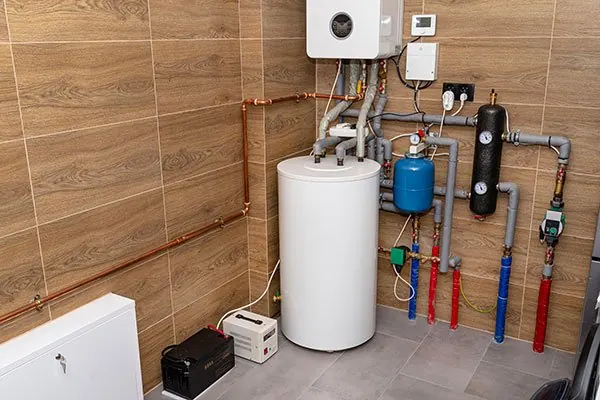
Gas hot water in Sydney
Gas hot water systems heat water by burning natural gas or LPG, either in a storage tank or as the water flows through a continuous flow unit. They are common across Sydney wherever mains gas is connected, from older brick homes in the west to townhouses in the Hills. Hot Water System Sydney arranges independent local licensed plumbers and gasfitters to install, replace and repair them, with a written quote first.
Gas storage tanks
A gas storage system has a burner underneath an insulated tank, keeping a set volume of water hot. Sizes for houses commonly range from around 90 to 170 litres or more. Outdoor models sit against an external wall on a base; indoor models need a flue to take exhaust gases outside.
Why people choose them: simple, no power point needed, quick to recover compared with electric storage, and a straightforward like-for-like swap in homes that already have one.
Trade-offs: the tank keeps water hot all day, so some energy is lost as standing heat, and a busy household can still run it out.
Gas continuous flow
A continuous flow (sometimes called instantaneous or tankless) unit heats water only when a hot tap is opened. A sensor detects flow, the burner fires, and the water is heated as it passes through a heat exchanger. Units are rated by flow rate in litres per minute.
Why people choose them: they do not run out, there is no tank losing heat, and the compact wall-mounted unit suits narrow side passages and townhouses.
Trade-offs: they need a power point, they draw a lot of gas while running, and the gas meter and pipe must be able to supply that rate. Older homes with a small meter or narrow pipe may need an upgrade, which should be on the quote. There can also be a short delay before hot water arrives, as with any system.
Sizing gas systems
For storage tanks, sizing comes down to the number of people and how many showers run back to back. For continuous flow, it is the number of outlets used at the same time and the temperature rise needed. Cold incoming water in winter, especially in western Sydney, means the unit has to lift the temperature further, so a unit that is just big enough in summer may struggle in July.
Gas supply and the gas meter
Most of the gas network serving Sydney homes is owned by a distribution company, while you are billed by your retailer. If your home is not connected and you want gas, a new connection is a separate process and adds time. If you are already connected and moving to continuous flow, the gasfitter should confirm that the meter and pipework can supply the unit's maximum gas demand.
Common gas hot water problems
- Pilot will not stay lit — often a thermocouple or gas control valve fault on storage tanks.
- No ignition on continuous flow — power supply, igniter or an error code pointing to a component.
- Lukewarm water — undersized unit, incorrect settings, a faulty tempering valve, or limited gas supply.
- Smell of gas — turn the gas off at the meter, do not use switches or flames, ventilate, and call the gas network's emergency line or a licensed gasfitter immediately.
Our hot water repairs page explains what each fault usually means.
Licensing and compliance
Gas appliance installation in NSW is gasfitting work and must be done by a licensed gasfitter; the water connections are plumbing work. NSW Fair Trading licenses both. We ask the contractors we work with to hold the licences and insurance the job needs — ask to see them before work starts, and ask for the gas and plumbing certificates of compliance once the job is complete.
Prices
Gas storage and continuous flow price bands, including the cost of gas pipe upgrades, are on our hot water system cost guide. If you are weighing gas against a heat pump, see heat pump and solar hot water.